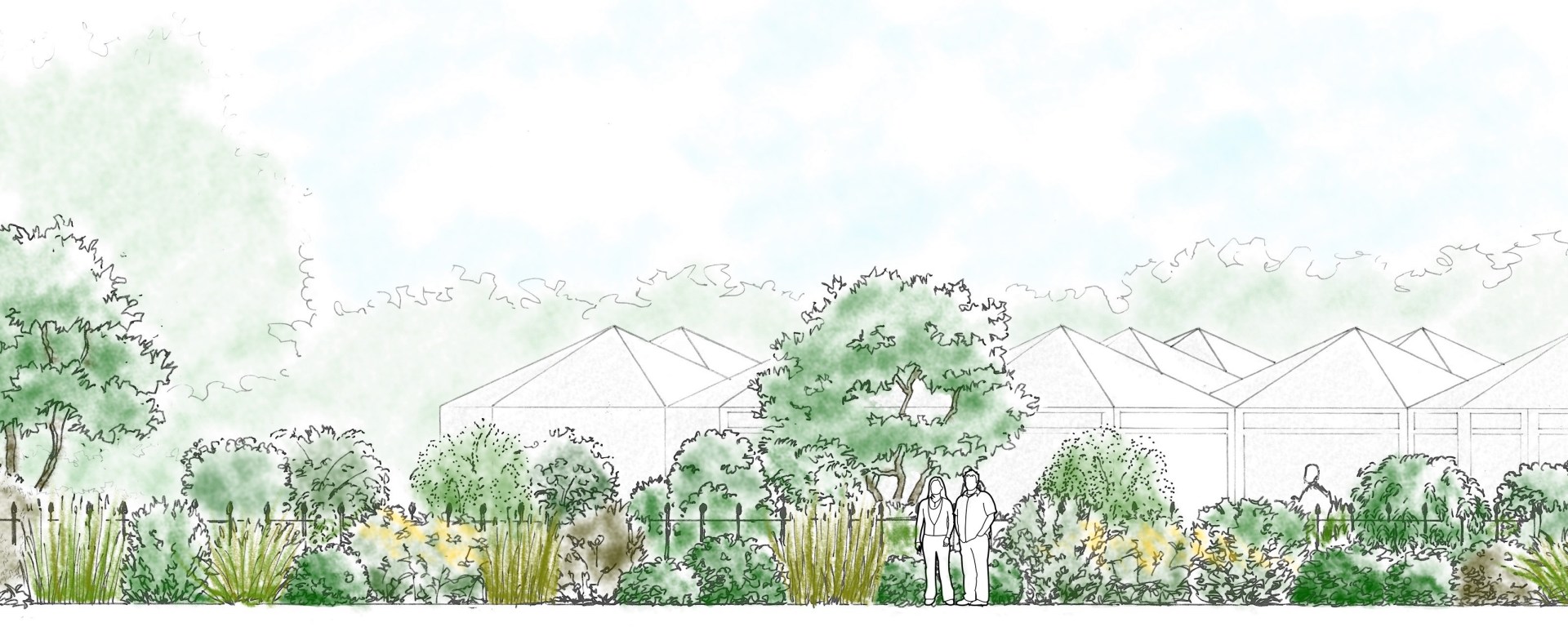
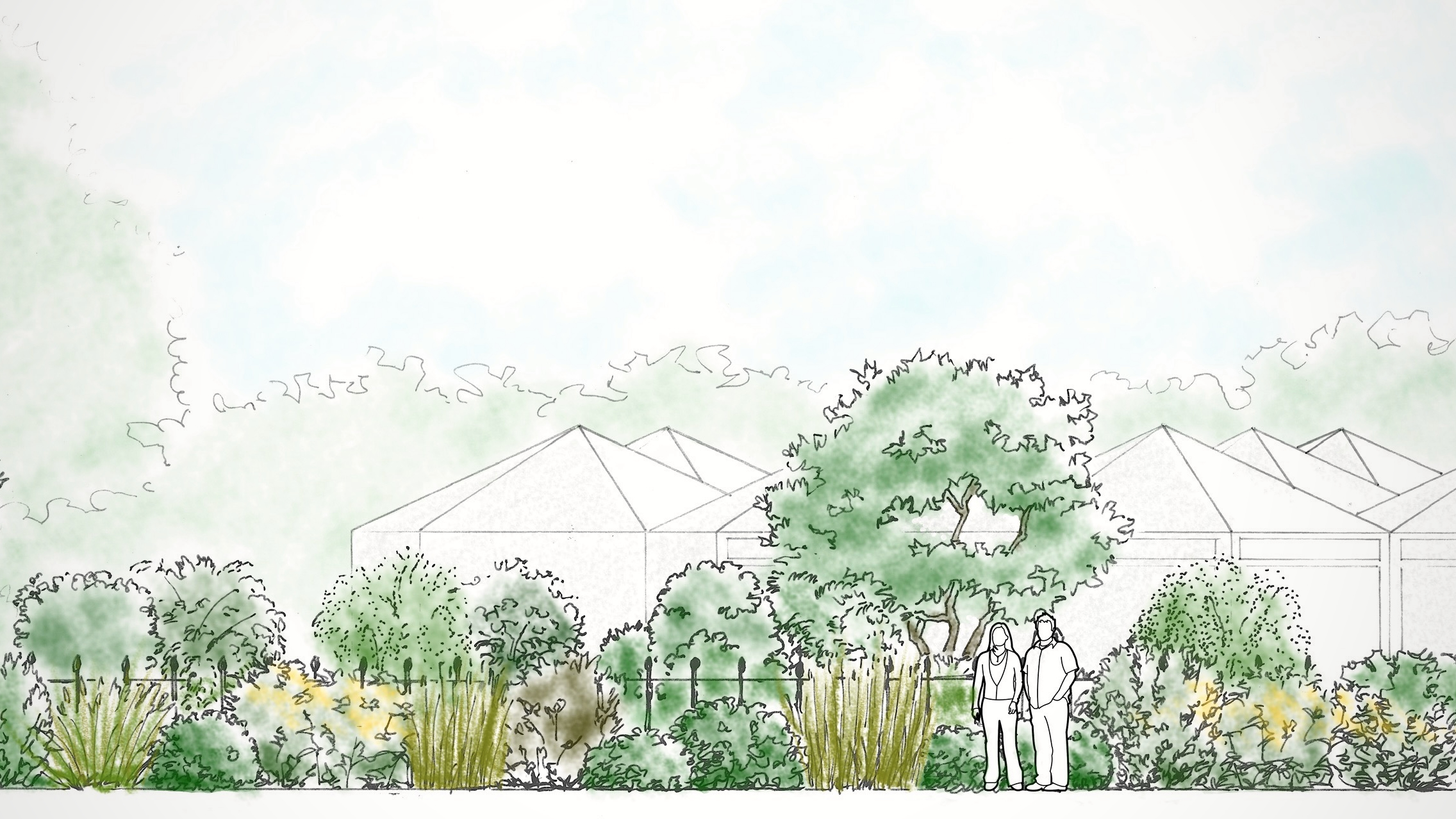
Queen Mary’s Gardens café, at the heart of Regent’s Park, is a popular place year round, and its front garden is a key part of the experience. Whether you’re coming in for a drink while out for a stroll on a bright spring morning, or a cyclist on a break during a wet winter training day, or a theatre-goer on a summer evening – you will be walking past or perhaps even through the garden before going in. And for any visitor entering Queen Mary’s Gardens from the western end, this corner site is a main marker on their journey around the park, and it sets the tone for their experience of the wider space. So, whatever the season, the planting has to work hard: it should invite you as you walk into the gardens, make the café’s terrace feel private enough but not enclosed, and generally be in keeping with the scale of the space.
The design develops along a meandering spine of evergreen shrubs which runs through the broadly L-shaped garden. There are tall shrubs, to provide intimacy for people enjoying drinks on the terrace, and mid-height shrubs, like windows in the planting, to allow people to look in or out.
Being a year-round garden, evergreen foliage plays an important part, but this doesn’t mean it’s all just one shade of green. Leaf colour varies from dark green to greys, and to pale chocolate to discrete variegation.
Three large sea buckthorns have been positioned to catch the visitor’s eyes as they walk on the terrace either from the entrance path or from inside the café, providing key focal points to visually travel across the garden. Sea buckthorns are tough, native plants with a delicate grey-green foliage. They will be grown as multi-stem small trees to provide dappled shade in the summer, late-season interest, and beautiful orange berries in the autumn.


Blues, yellows and oranges
The flowering season will kick off in the spring with the buttery yellow of Baptisia ‘Lemon Meringue’, combining later with the blues of Amsonia. As the season unfolds, the colours brighten up, with the deeper yellows and oranges of Rudbeckia, Helenium and Crocosmia, offset by the purpleish blue of Agastache and Asters into the autumn. These late-flowering perennials will help support insects and pollinators that are still buzzing around the park as the cool season sets in.
In between, bulbs will bring pops of orange, white and purple. Grasses have been used extensively to infill and to add movement throughout the year, adding a soft touch in the winter months among the rust-coloured seedheads.
Planting plan
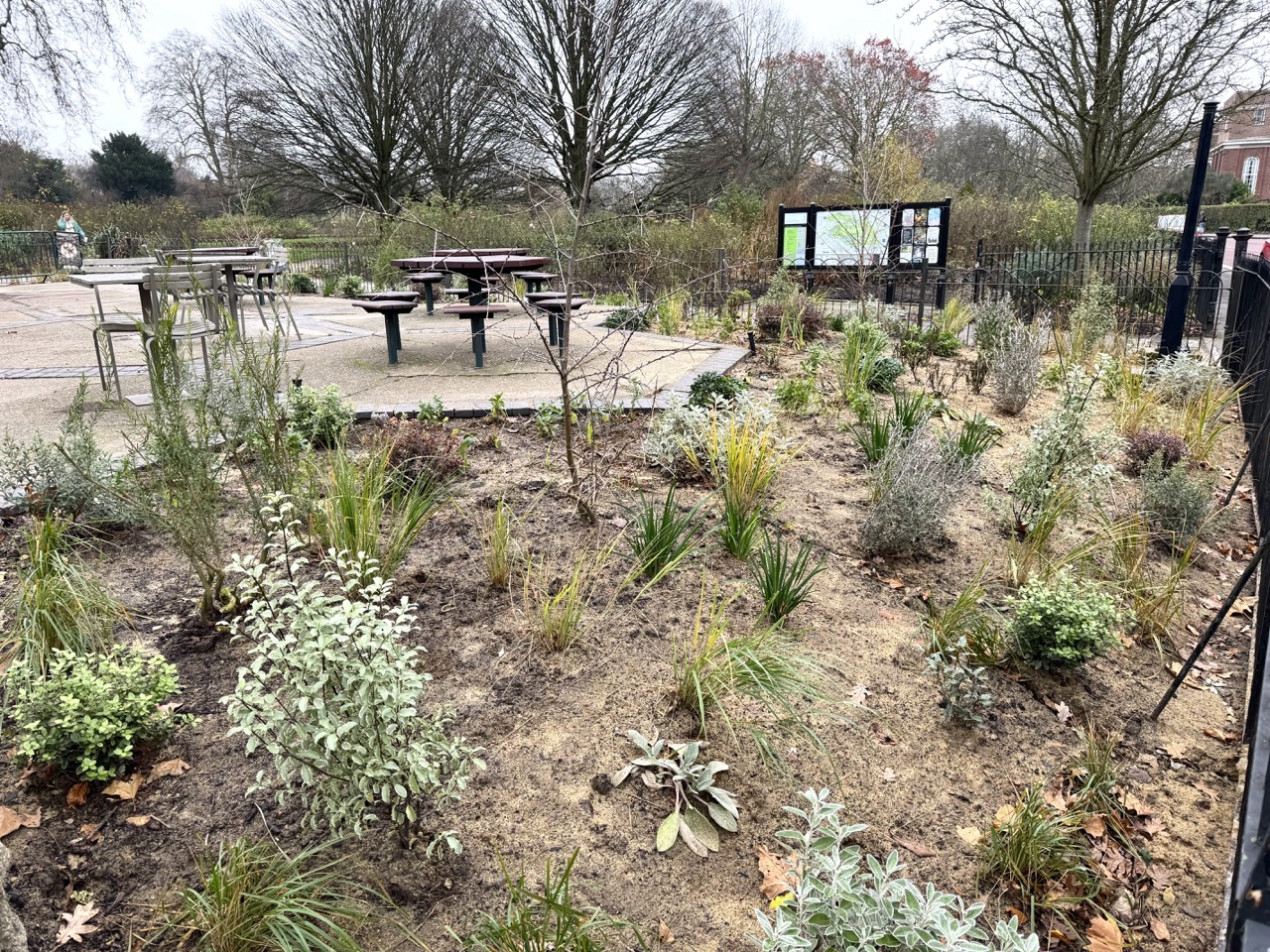
Planting day


More plants


Project status:
Planted November 2024
Plant photo credits: Agastache ‘Blue Fortune’: Claire Austin / Amsonia hubrichtii: Beth Chatto / Aster frikartii ‘Mönch’: Beth Chatto / Baptisia ‘Lemon Meringue’: Crocus / Calamagrostis brachytrica: Stonehouse Nurseries / Calamagrostis ‘Karl Foerster’: Beth Chatto / Calistemon sieberii: Eleplants Nursery / Corokia x virgata ‘Frosted Chocolate’: Architectural Plants / Crocosmia ‘George Davison’: Claire Austin / Helenium ‘Sahin’s Early Flowerer’: Beth Chatto / Hippophae rhamnoides: Ebben Nurseries / Libertia chilensis: Beth Chatto / Olearia macrodonta: TreesAndShrubsOnline / Pittosporum ‘Golf Ball’: ThePlantStore.co.nz / Pittosporum tobira ‘Nanum’: Crocus / Pittosporum tenuifolium ‘Silver Queen’: Architectural Plants / Pittosporum tenuifolium ‘Tom Thumb’: Emerald Plants / Rudbeckia fulgida ‘Goldstrum’: Beth Chatto / Rudbeckia subtomentosa ‘Henry Eilers’: Old Court Nurseries / Stipa calamagrostis: Beth Chatto / Tamarix ‘Hulsdonk White’: Le Jardin de Pascal.
 GILG GARDEN DESIGN